Showing posts with label picture time. Show all posts

Thursday, May 29, 2008

Aging codebases, a postscript

Ron Avitzur's comment on my post wondering aloud as to whether code can age gracefully done tickled my brain. I mean, I think about code a lot. I think about software and making software a lot.

But for some reason, I hadn't ever pondered how truly strange software is - if you look at it a certain way, it's never truly broken. It may be old, it may be ungainly, but it will always do something.

Sure, the hardware that it ran on may disappear or cease to function and the compilers may evaporate... but that doesn't mean that the code's broken. It just means that you've got a little work ahead of you porting that software to the latest and greatest hardware and toolchain and bingo bango your software's back from the dead.

Of course, there's always the question of "should we?". Times move on and inevitably reach a tipping point where maybe it makes sense to let that sleeping codebase lie.

Steve McConnell refers to this as a "doghouse problem" - when it comes to building a doghouse, everyone has an opinion on what color to paint it, what the roofing tiles should be, the exact dimensions, yadda yadda because it's a problem so eminently tractable that we can easily wrap our heads around it. Hell, it's within the realm of reason that we could build it ourselves. We have a pretty good idea of what it'll cost to make and how long it'll take.

But ask us to price the cost, materials, resources and time required to build a skyscraper and... good luck on estimating that one. How hard can it really be though? They're both buildings, right?

A couple of real-world buildings brought this into clear focus for me.


First is an old mill building not too far from where I live. For the years I've been here, it's been uninhabited - a hulking, crumbling mess of a building. 100 years ago, I'm sure it was a bustling center of commerce, an economic powerhouse. Now it's gone past creepy and into sad. It's being demolished to make way for... I don't know. Probably another drug store or something.
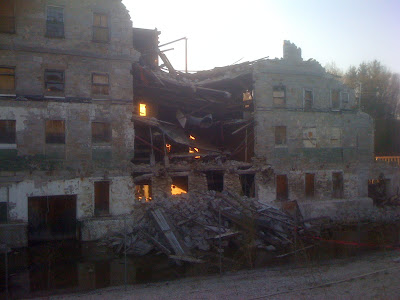


(zoom on the crumble)


Second is This Old House, or what's left of it. There was a house there once, nothing here now but the bones of the old building rising like so many dinosaur bones from the ground.
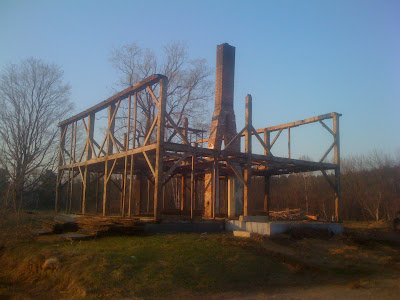


(check them bones)


Either one of them could be broken down as much as possible to be built back up to work again, but it's the house whose bones will remain in place while the mill's ground into the dust. Looking at it, the possibility of fixing it piecemeal doesn't even enter into your mind - it's over a hundred years old, frigging brick and huge. The house, on the other hand? Over a hundred years old, but the frame and chimney are still sound - we can rebuild around them, putting the walls and stairs and windows in different this time.

When looking at open source projects, it's not uncommon for one of the mentioned features to be their "clean codebase" - on some level, this is kind of laughable because who but a geek gives a shit what the code looks like as long as it runs well enough and does something useful for you?

On another level, it shows that there's people who have taken pride in their work, that fix broken windows, and have a vested interest in making sure that a year from now, it will have crumbled less than that mill building.


Think about building something that will stand the test of time and it just might. Make it concise and useful enough and who knows? Its framework just might live a decade or so.

I hope to someday build something so good that I won't be able to hear the lamentations of the developers responsible for supporting it because I'm busy watching Wheel of Fortune too loud or whatever it is that incredibly old people do. Did I mention that I'm watching The Wheel in my rocket car? Because ideally, I'm incredibly old, reasonably well-to-do and the future finally delivers on its promises.


Postscript


I biked by the house again earlier this week. Nothing remained.

I still hold out hope for a rocket car-filled future.

Saturday, April 19, 2008

Can codebases gracefully age?

Terrible shame. Monstrous shame.

I really need to stop looking at my old code. More than that, I need my old code to work all the time in the face of needs and requirements that didn't exist when I first wrote it. Is that even possible? It isn't when I put it like that.

Probably not. At this point, I'd say "almost certainly not," but it's not like I've seen a whole lot of other projects' codebases (it's not something that I do for fun).

The sad thing is that, not to sound like a monstrously arrogant prick (even though I am), I'm the best developer where I work, by far. When Larry O'Brien made the observation that bad developers are actively counter-productive, it riled some people, but I'm in complete agreement. I'm the best developer at my office (sometimes by more than an order of magnitude) and I'm out-and-out embarrassed by code I wrote six months ago. As in "how the fuck did this shit ever work?" embarrassed. As in "if I ever come across a time machine, I'm going back in time to punch myself in the throat for that mess" embarrassed.

And it only gets worse.

This isn't humility, this is common sense. Microsoft doesn't want me, Google wouldn't fart in my general direction. I'm pretty sure even Fake Steve Jobs would prefer that I not have any Apple products.

I'm certainly no superstar developer (do they really exist in nature?), but even developers way smarter and better than I am have problems with their codebases, especially as they age.

Microsoft's not having such a smooth time of things with Vista - people are hating it so much that they're apparently seriously thinking about doing away with backwards compatibility, regarded by some as the albatross around Vista's neck. But... backwards compatibility is what sells Microsoft products for a whole lot of people. Microsoft's got scary smart dudes working to insure that your old software will keep working, even if it means that old, really questionable stuff, stays in the OS to keep it working.

They must make bunches of money off of it (there's a school of thought that says that the solid support/backwards compatibility fuels the virtuous cycle that keeps large companies from jumping ship from Microsoft), but with the time overrun and backlash about how assy Vista is, they're thinking about sacrificing a cash cow for a restart on the accretion of bugs they have to support in their codebase.

Apple's another company that's got scary smart dudes working for them. Like, even the guys that don't really work for them are scary smart. Another place where I'm sure I'm the janitors are smarter than I am. Even they've got problems with their codebase.

Even there, when it came time for OS X to come out, they broke backwards compatibility with System 9. There was an emulator or something for it (I could swear my PowerBook has it on it) but they made a clean break of it. With point releases of OS X, they brutally deprecate features and functions, leaving developers to clean up their act or not run in the new version.

It's kind of rough, but it's probably also the right way to go. Yes, as a first course, you want to refactor the hell out of your code. But they've accepted the fact that their codebase doesn't age gracefully and when they find really objectionable code, they rip it out as soon as they can. Developers who support Apple apps seem to not mind it all that much (maybe they do?). As for the users... compare and contrast people's reaction to Leopard and Vista.

I just don't think that it's possible for code to age well. Bits and pieces may stand the test of time, but the whole will become a not-so-secret shame. Well, maybe TeX has aged gracefully, but (and no offense intended) nobody who's as smart as Donald Knuth is wasting their time reading this blog.


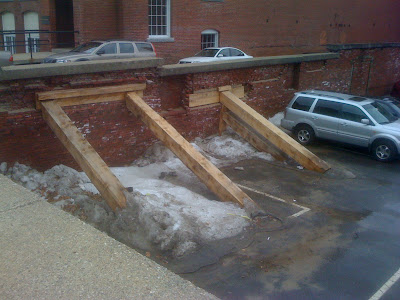
(click for more bigger brick)

I think that's a totally lovely sight, but if that were software, a bunch of people (the developers supporting it, the people trying to sell it) would be in a lot of pain because that is unfit.

I mean, OK. First it was designed as a brick edifice to hold a building up. Then someone decided that we could slap an ad for Coca-Cola on it. Then a real genius figured "hey, it worked for Coke, why not make it work for Gold Medal", and in the process, they lost sight of what it could reasonably support.

If that were software, I'd be scared to touch it - if I do anything with it, I'm going to lose the Gold Medal ad or the Coca-Cola ad or both or the lovely interplay between the two. I don't want to be responsible for fucking them up.

It only overtly serves one of its intended functions well at this point, when, if it were software, people would be demanding it support all three. At this point, we can all agree that there are simpler ways to support multiple ads (they're called billboards, have you heard of them?) and maybe we should just strip it back to what it can do well (be a brick wall).

In the face of all this, why do I keep developing? In the hope that next time I'll get it right.

So what about you out there - do any of you work on applications that only get better with age?

Sunday, April 13, 2008

Carrot in the toaster

I realize that it lacks the effortless panache of the banana in the tailpipe, but I'd like to introduce the world to a new, insane meme, the meaning of which will take generations to decipher - the carrot in the toaster.


(blow it up!)


Come summertime, I like to grill carrots. I'm OK with cooked carrots, honest. But an unpeeled carrot thrown right in a grimy toaster oven? There's something so very wrong with that.


This is truly a disturbing world that we live in.

Tuesday, April 1, 2008

What does your app's codebase look like?

I took this snapshot in the parking lot at my building. I can't say that our application's architecture intentionally derived its inspiration from it, but there is an eerie similarity.


(click to blow up the tragedy)


Ha ha, only serious.

Sunday, March 30, 2008

My (current) favorite picture in the world

I was walking through downtown Manchester a couple of weeks ago, and this sign called out to me with its beautiful, terrible siren cry.


(click to blow it up)


If you're going to ask me what's so beautiful about it, you may as well ask me where it all went wrong and where you lost your soul from childhood up to here. It's really the final admonition ("NO ESCORTS") that puts it over the top for me - it displays a remarkable economy of language that I obviously have no facility for. At the very least, it tells the passer-by "we've been asked that goddamned question so many times we have to put it out in front so people don't ask again (and they probably will anyway)."


I love this picture in an inappropriate way. Or appropriate, I don't know.

Tuesday, March 25, 2008

So, about that Microsoft-Yahoo Merger

So it was a slow day and I was reading about the Microsoft-Yahoo merger. How developers at Yahoo are fleeing in droves because Microsoft doesn't get the 'net and will ruin Yahoo.

And this isn't so say that they're wrong, but how about fleeing Yahoo for a better reason? Like, say, because of this embarrassment puddle parked out on the street in front of my shonky whip? I mean, come on Yahoo. I've never seen a Googlemobile, but I suspect that they're not quite as... butch as this one is.


(click to engorge this shameful display)

I've got no eye for color or detail, but... fuscia with the cheesy flame job? Really?

Then again, it did bring a smile to my face. For all the wrong reasons, but I was smiling. Way to go, Yahoo. Good luck keeping the corrupting influence of Microsoft far away from your pristine shores.